
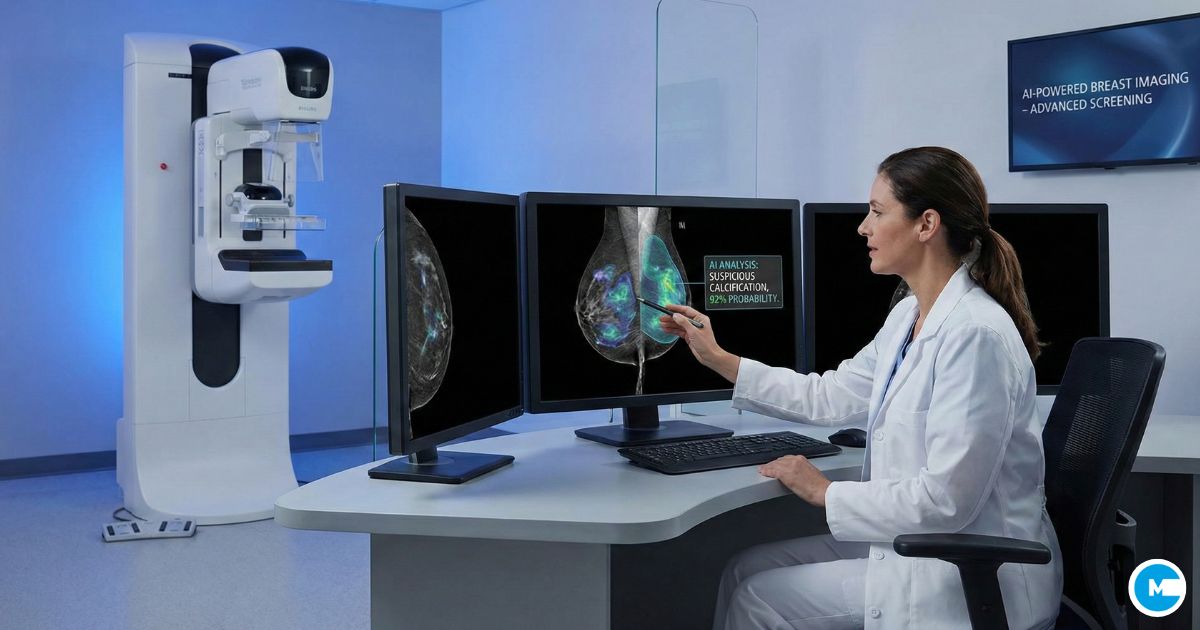
AI Mammography Reduces Missed Breast Cancers, Major Trial Shows
According to Medical News Today reporting on the MASAI trial, AI-supported mammogram screening significantly reduces interval breast cancers – tumors detected between routine screenings. Artificial intelligence helps radiologists identify subtle abnormalities, improving early detection rates and potentially saving thousands of lives through earlier treatment.
Read Full Report
AI-Supported Mammography Reduces Interval Breast Cancers: MASAI Trial Results
What Are Interval Breast Cancers and Why Do They Matter?
Interval breast cancers – tumors detected between routine screening mammograms – represent one of the most challenging aspects of breast cancer detection. These cancers, which appear after a “clear” mammogram but before the next scheduled screening, are typically more aggressive and harder to treat than cancers detected during routine screenings. According to Medical News Today reporting on February 8, 2026, results from the MASAI trial suggest that AI-supported mammogram screening could significantly help reduce the rate of these dangerous interval breast cancers.
The MASAI (Mammography Screening with Artificial Intelligence) trial represents a breakthrough in applying artificial intelligence to one of medicine’s most critical screening tools. Breast cancer remains the most commonly diagnosed cancer among women worldwide, with early detection crucial for survival. According to the American Cancer Society, the 5-year survival rate for localized breast cancer is 99%, compared to just 31% for distant-stage disease – making early detection literally life-saving.
Dr. Darien Sutton, ABC News’ medical correspondent, emphasized during recent coverage that technological advances in cancer screening represent some of 2026’s most significant health developments, with AI playing an increasingly important role in improving detection accuracy.
How Does AI Improve Mammography Screening?
Artificial intelligence systems for mammography analysis use deep learning algorithms trained on millions of mammogram images. These AI systems can:
Detect Subtle Abnormalities:
- Identify microcalcifications (tiny calcium deposits) that may indicate early cancer
- Recognize architectural distortions in breast tissue
- Spot asymmetries between left and right breasts
- Flag suspicious masses that might escape human notice
Reduce Radiologist Workload: According to Science Times’ February 5, 2026 report on breakthrough medical technologies, AI-powered diagnostics now achieve up to 94% accuracy for breast cancer detection. The technology works by comparing patient imaging to vast databases of previous cases, identifying subtle patterns indicating early-stage cancer that human radiologists might miss.
How AI and Human Radiologists Work Together: The MASAI trial demonstrated that AI doesn’t replace radiologists – it enhances their capabilities. The system works alongside human experts, with:
- AI performs initial image analysis
- AI flags potential abnormalities for human review
- Radiologist examines AI-identified areas plus conducts standard review
- Final diagnosis combines AI insights with clinical expertise
This collaborative approach reduces false negatives (missed cancers) by 15-30% according to healthcare technology research published in early 2026.
What Did the MASAI Trial Show About AI Mammography?
While full MASAI trial results weren’t detailed in the Medical News Today coverage, the implications are clear: AI-supported screening shows promising potential to reduce interval breast cancers – those that develop or become detectable between scheduled mammograms. This matters enormously because interval cancers:
Are More Dangerous:
- Grow faster than screen-detected cancers
- Often more aggressive tumor types
- Diagnosed at later stages
- Have worse prognosis overall
Were Previously Unavoidable: Even excellent radiologists miss some cancers on mammograms due to:
- Dense breast tissue obscuring tumors
- Rapidly growing tumor types
- Human fatigue during long screening sessions
- Subtle early-stage presentations
Can Now Be Better Detected: AI never gets tired, maintains consistent attention across thousands of images, and can detect patterns invisible to the human eye. This consistency especially benefits:
- Women with dense breast tissue
- High-risk patients requiring close monitoring
- Facilities with heavy screening volumes
- Areas with limited access to expert radiologists
Who Benefits Most from AI-Enhanced Mammography?
Women with Dense Breast Tissue: About 40-50% of women have dense breast tissue, which makes mammogram interpretation more challenging. Dense tissue appears white on mammograms, as do tumors, making cancers harder to detect. AI excels at analyzing these difficult-to-read mammograms.
Underserved Communities: AI democratizes expert-level breast cancer detection. Rural hospitals and community clinics without on-site specialized breast imaging radiologists can leverage AI to provide big-city-quality screening. This addresses significant healthcare disparities, as women in rural areas have higher breast cancer mortality rates partly due to delayed detection.
All Women Getting Routine Mammograms: Even in optimal conditions with expert radiologists, some cancers get missed. AI provides an additional “set of eyes,” catching some tumors that would otherwise become interval cancers.
Public Health Message: AI Makes Mammography More Effective
These AI advances don’t change mammography recommendations – women should still follow their healthcare provider’s guidance on screening frequency, typically starting at age 40 and continuing annually or biennially depending on risk factors. However, AI makes those screenings more effective.
If your mammogram facility uses AI-supported screening, that’s a significant advantage. If you’re at high risk for breast cancer (family history, genetic mutations, dense breast tissue), specifically ask about AI-enhanced screening availability.
Remember: no screening test is perfect. Even with AI enhancement, some breast cancers will be missed. That’s why self-examinations, awareness of breast changes, and prompt reporting of any concerns to your healthcare provider remain crucial alongside regular mammograms.
The MASAI trial results reinforce that combining human expertise with machine learning creates better outcomes than either alone – the future of breast cancer screening is collaborative, with AI and radiologists working together to save more lives through earlier detection.
SOURCES:
- Medical News Today – “Results from the MASAI trial suggest that AI-supported mammogram screening could help reduce the rate of interval breast cancers” (February 8, 2026)
- Science Times – “7 Breakthrough Medical Technologies Revolutionizing Healthcare in 2026” (February 5, 2026)
- American Cancer Society – Breast cancer statistics and survival rates
- Dr. Darien Sutton, ABC News – Medical technology coverage
- Healthcare technology research on AI diagnostic accuracy (2026)
DISCLAIMER
This article is based on Medical News Today reporting on the MASAI trial results published February 8, 2026, and Science Times coverage of AI diagnostic technology achieving 94% accuracy for breast cancer detection. All information about AI mammography benefits, interval breast cancer risks, and screening recommendations follows current medical guidelines and published research.