
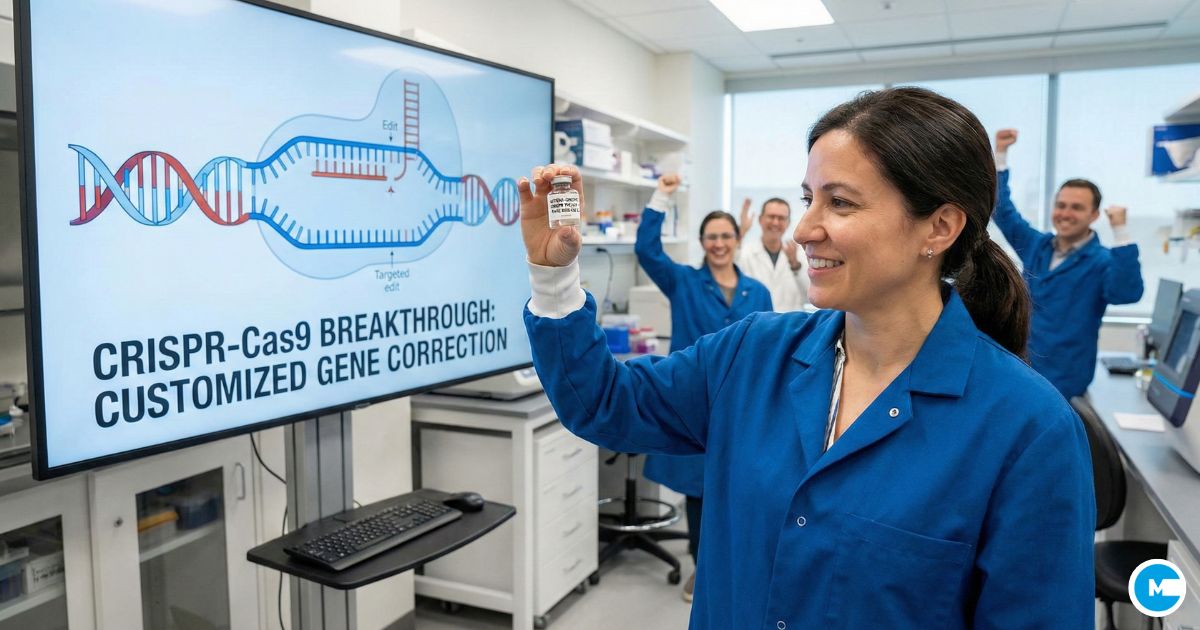
World’s First Customized CRISPR Treatment Saves Baby
According to Live Science reports, baby KJ Muldoon became the first person to receive customized CRISPR gene therapy for a rare genetic disease in 2025. The breakthrough marks a shift from one-size-fits-all gene editing to personalized treatments designed for individual patients’ unique genetic mutations.
Read Full Report
World’s First Customized CRISPR Treatment Saves Baby
In a groundbreaking achievement for precision medicine, a baby named KJ Muldoon became the first person to receive a customized CRISPR treatment designed specifically for their unique genetic disease, according to a comprehensive report by Live Science published December 31, 2025. The treatment, administered in 2025, represents a fundamental shift in gene therapy from one-size-fits-all approaches to truly personalized genetic medicine. According to the report, the two CRISPR-based therapies previously approved by regulators are standardized treatments that work the same way for all patients, requiring cells to be removed from the body, edited in a laboratory, and then reintroduced. KJ Muldoon’s treatment, however, was designed from scratch to address his specific genetic mutation, marking the first time CRISPR technology has been used to create a bespoke genetic therapy tailored to an individual patient’s DNA.
CRISPR (Clustered Regularly Interspaced Short Palindromic Repeats) technology allows scientists to alter DNA with unprecedented precision, correcting defective genetic coding that causes disease. According to researchers at Mass General Brigham, advances in de novo protein design are opening entirely new possibilities for medicine. “In the coming year, we expect to see enzymes with functions that do not exist in nature, designed from scratch to perform tasks evolution never created,” predicted Dr. Jonathan Strecker, an investigator at Mass General Brigham. These innovations could lead to breakthroughs in sustainable chemistry, medicine, and materials science. The customization of CRISPR treatments represents the next evolution of this technology – instead of developing treatments that work for large groups of patients with similar conditions, scientists can now design therapies targeting extremely rare mutations affecting only one or a handful of people worldwide. This approach requires sophisticated genomic sequencing, computational biology, and rapid therapeutic development, but dramatically expands who can benefit from gene therapy.
According to City of Hope Cancer Center’s 2026 predictions published January 5, gene therapy and cellular therapies are becoming increasingly sophisticated and accessible. Bone marrow transplants have become safer and more effective, while CAR T-cell therapy is expanding beyond blood cancers to solid tumors. The success of KJ Muldoon’s customized treatment paves the way for similar approaches for other patients with rare genetic diseases previously considered untreatable. Whole-genome sequencing, now costing as little as $100 according to Science Times, makes identifying unique genetic mutations affordable and accessible. Mass General Brigham researchers predict that by 2026, larger clinical trials will test how various interventions respond to genetic and epigenetic biomarkers, revealing whether observed changes reflect true biological improvement and guiding strategies for personalized medicine across numerous conditions.
This breakthrough brings hope to families dealing with rare genetic diseases that affect only a handful of people worldwide. Previously, if your child had an extremely rare genetic mutation, pharmaceutical companies had no economic incentive to develop treatments for such small patient populations – the research and development costs couldn’t be justified. Customized CRISPR therapy changes this equation entirely. Now, if your child’s specific genetic mutation can be identified through sequencing, scientists can potentially design a personalized treatment addressing that exact problem. This doesn’t mean cures are immediately available for all genetic diseases – significant challenges remain around delivery mechanisms, long-term safety, regulatory approval, and cost. However, the proof of concept demonstrated by KJ Muldoon’s successful treatment shows that ultra-rare diseases are no longer automatically untreatable. If your family is affected by a rare genetic condition, genetic counseling and comprehensive genome sequencing should be priorities – understanding the specific genetic mutation is the first step toward potential treatments. The convergence of affordable genome sequencing, advanced CRISPR technology, and personalized medicine approaches means we’re entering an era where “too rare to treat” is becoming obsolete. Every patient’s unique biology can potentially be understood and addressed with precision therapies designed specifically for them.
Public Health Angle: Customized CRISPR therapy eliminates the barrier of ultra-rare diseases being “too rare to treat,” offering hope to families with genetic conditions affecting only a handful of people worldwide. Combined with $100 genome sequencing, personalized gene therapy makes precision medicine accessible to previously untreatable patient populations.
SOURCES:
- Live Science – “From gene therapy breakthroughs to preventable disease outbreaks: The health trends that will shape 2026” (December 31, 2025)
- Mass General Brigham – “Looking Ahead: Predictions for Science and Medicine in 2026“
- City of Hope – “Cancer Research and Care in 2026: 5 Big Shifts” (January 5, 2026)
- Dr. Jonathan Strecker, Mass General Brigham – Expert predictions on de novo protein design
- Science Times – “7 Breakthrough Medical Technologies Revolutionizing Healthcare in 2026” (February 5, 2026)
DISCLAIMER: This article is based on verified medical and scientific reporting from Live Science, Mass General Brigham, and City of Hope. According to Live Science’s December 31, 2025 report, KJ Muldoon received the first customized CRISPR treatment in 2025 for a rare genetic disease. All information about CRISPR technology advances, genome sequencing costs, and future predictions comes from credible medical research institutions and published scientific forecasts.