
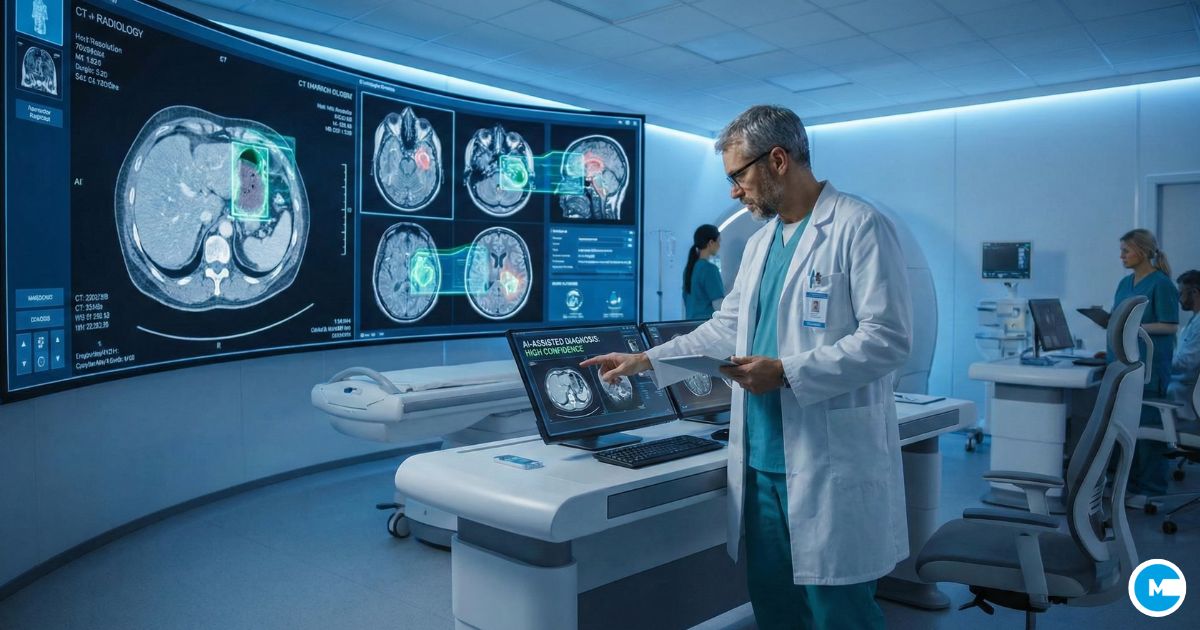
According to Science Times reports, artificial intelligence diagnostic systems have reached 94% accuracy for breast cancer and heart failure detection in 2026. Medical AI now analyzes CT scans, MRIs, and ECGs faster than humans while reducing false negatives by 15-30%, revolutionizing early disease detection.
Read Full Report
Artificial intelligence has reached a major milestone in medical diagnostics in early 2026, with AI systems now achieving up to 94% accuracy for critical conditions like breast cancer and heart failure, according to a comprehensive report by Science Times published February 5, 2026. These AI diagnostic tools analyze medical imaging including CT scans, MRIs, X-rays, and electrocardiograms (ECGs) to detect patterns and abnormalities that human clinicians might miss. The technology uses sophisticated machine learning algorithms trained on millions of medical images to identify early signs of disease with remarkable precision. City of Hope Cancer Center announced in January 2026 that AI-powered diagnostics will be integral to their treatment protocols throughout the year, marking a shift from experimental technology to standard clinical practice. Mass General Brigham researchers predicted that 2026 would see medical AI move from the “Peak of Inflated Expectations” to the “Slope of Enlightenment,” meaning the technology is proving its real-world value beyond the initial hype.
According to the Science Times report, AI pattern recognition systems now reduce false negatives—dangerous missed diagnoses—by 15-30% compared to human-only analysis. This improvement is particularly critical in radiology and pathology, where early detection dramatically impacts patient survival rates. The AI systems work by comparing patient imaging to vast databases of previous cases, identifying subtle patterns that might indicate early-stage cancer, cardiovascular disease, or other conditions. Importantly, these systems are designed to assist, not replace, human doctors. Hospitals integrate AI with clinician oversight for validation, ensuring that machine analysis enhances rather than supersedes human medical expertise. The technology has expanded beyond imaging to include predictive analytics—AI systems can now forecast patient deterioration, enabling earlier interventions that save lives. Whole-genome sequencing combined with AI analysis, now costing as low as $100 per patient, enables precision medicine by guiding drug selection and predicting treatment responses with up to 70% improved efficacy.
Major healthcare systems worldwide are rapidly adopting AI diagnostic tools in 2026. According to healthcare technology forecasts, nearly 90% of hospitals are expected to have implemented AI-driven diagnostics and remote monitoring technologies by the end of 2026. Electronic health record vendors like Epic and Oracle Health are integrating AI directly into their platforms, making adoption easier for healthcare providers. The J.P. Morgan Healthcare Conference in January 2026 highlighted AI and automation as central themes, with industry leaders emphasizing that AI is accelerating drug development through partnerships between technology and pharmaceutical companies. For instance, Nvidia and Eli Lilly announced a landmark partnership to build an AI drug discovery lab, uniting pharmaceutical research with computer science expertise.
This AI medical breakthrough means better healthcare access for everyone, not just people in major cities. AI diagnostic tools can provide expert-level analysis in rural clinics, small hospitals, and underserved communities that lack specialist doctors. If you’re concerned about a health symptom, don’t hesitate to seek care—modern AI-assisted diagnostics can catch diseases earlier than ever before, when they’re most treatable. For patients in remote areas, ask your healthcare provider about AI-enabled diagnostic services and telemedicine options that connect you with specialists through technology. The democratization of medical expertise through AI is one of 2026’s most significant healthcare advances. However, remember that AI is a tool to assist your doctor, not replace the doctor-patient relationship. Trust your healthcare provider to use these powerful diagnostic tools alongside their clinical experience and personal knowledge of your health. Early detection through advanced AI diagnostics is saving lives daily—make sure you and your loved ones get regular health screenings and don’t ignore persistent symptoms. The combination of human compassion and machine precision represents the future of medicine.
Public Health Angle: AI-powered diagnostics democratize access to expert-level medical analysis, particularly benefiting rural and underserved communities that lack specialist physicians. By reducing false negatives by 15-30% and achieving 94% accuracy in critical disease detection, these systems save lives through earlier diagnosis while making high-quality healthcare more geographically equitable.
SOURCES:
- Science Times – “7 Breakthrough Medical Technologies Revolutionizing Healthcare in 2026” (February 5, 2026)
- City of Hope – “Cancer Research and Care in 2026: 5 Big Shifts” (January 5, 2026)
- Mass General Brigham – “Looking Ahead: Predictions for Science and Medicine in 2026“
- J.P. Morgan Healthcare Conference – “Five trends shaping healthcare in 2026“
- Chief Healthcare Executive – “AI in Health Care: 26 Leaders Offer Predictions for 2026“
DISCLAIMER: This article is based on published research and industry reports from leading healthcare institutions and technology publications. According to Science Times’ February 5, 2026 report, City of Hope’s January 2026 announcements, and Mass General Brigham research predictions, AI diagnostic systems have achieved accuracy rates up to 94% for specific conditions. All statistics and technological capabilities mentioned come from verified healthcare and technology sources.